Blog / Events / Journalists
Challenges and changes of reporting on war in a social media age
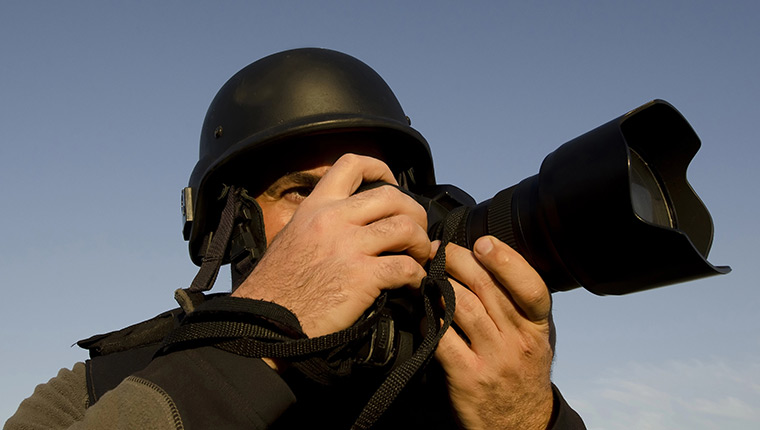

Social media and the digital revolution within the media industry have completely transformed the way that audiences get their news. Many people will first hear of a news story via social media platforms such as X (formerly Twitter) or TikTok. So how are journalists dealing with this new media landscape, especially when covering topics like war and conflict?
The Civic Journalism Lab at Newcastle University recently held a webinar discussing the current challenges that war reporters are facing, the importance of how information is obtained and verified, and the ways in which war reporting can stand out in 2026.
Current challenges
The growth of online media means there is a wealth of information available to audiences and Shayan Sardarizadeh, senior journalist at BBC Verify, believes that ‘every war in the 21st century is the best possible documented war that we’ve seen’ due to social media. The problem with so much being shared online means that audiences become impatient to find out the facts, as Shayan explained:
‘If a bomb goes off somewhere in Gaza, people want to know very quickly, who did it? Who was killed? Was it justified or unjustified? But for a war where you can’t actually go and investigate what’s happened, as you don’t have access, then you have to rely on social media and people on the ground who might have witnessed this incident. This takes time to verify and investigate’.
Christina Lamb, chief foreign correspondent at The Sunday Times, mentioned the change from her early days as a foreign reporter. Back then, she would be in countries for weeks before filing a report – now, reporters are ‘under pressure to file from anywhere immediately, because they can’, which can lead to mistakes and generalisations. She also made a point about war reporters being deliberately targeted:
‘What we’re seeing now is people specifically being targeted because they’re wearing a jacket that has “press” in big white letters, rather than it protecting them. It’s happening on such a scale in Gaza and Lebanon that if we don’t make a stand against it then it’s going to be normalised’.
Francis Farrell, reporter at the Kyiv Independent, backed this up by saying how the front line in Ukraine had become more dangerous due to Russian first person view drones. He also argued another challenge is ‘war fatigue’ and that audiences are losing interest due to the amount of conflicts that are happening across the world.
The importance of information and how it is spread
Intertwined with the challenges that journalists face in war reporting now, is how information is distributed. Florian Zollmann, senior lecturer in journalism at Newcastle University, argued that we are now in an era of ‘diffused information’, where events can be recorded and distributed using mobile phones, cameras and social media applications. Florian elaborated and said ‘it could be argued that diffused information is largely not journalism, but a mix of user generated content at the same time. This new sphere of media is also prone to disinformation and propaganda’.
Dina Matar, professor of political communication and Arab media at SOAS University of London, feels that legitimacy in talking about these wars plays an important role:
‘We have local content creators who have taken on the role of a journalist but they are not acknowledged as such by anyone outside, apart from people who want to follow them. So they are not really talked about as legitimate journalists’.
While social media has come to the fore, legacy media is still prominent. Florian said ‘the 2025 report of the Media Reform Coalition research by Dr Tom Chiver stated that three companies; DMG media, News UK and Reach plc control 90% of UK national newspaper circulation, which is a 20% increase in market concentration since 2014. Moreover, these same three companies account for over 40% of the combined reach of the UK’s top 50 online news brands’.
The need to verify
The nature of war and conflict now means ‘it’s become very difficult to find out what’s actually true’ according to Shayan. Christina backed this point up by talking about the fact that there are numerous places that journalists can’t report from, meaning they are totally reliant on people on the ground:
‘I’m all in favour of local people being able to report, but sometimes it’s more difficult for them because they’re under pressure from their regime or government. Therefore, having someone from outside going in, who then flies away again, is actually a useful thing’.
All of this social media footage needs to be verified. Shayan said that the BBC Verify team have already checked over 1000 videos in relation to the war in Gaza. He stressed that all journalists ‘need to have an understanding of how to verify a video’. You need to ‘deeply investigate the source of a video that looks believable. You need to look at the context of the video and who first shared this video. Go check their account on Tiktok or Instagram. Do they have a history of sharing or creating AI videos? Are they a trusted source of information?’
Shayan also made the point that free AI check tools are ‘not reliable at all’ yet.
How to stand out in 2026
War reporting is continuing to change and adapt to this new media landscape but Shayan believes that the old principle of journalism of relying on evidence still rings true today:
‘Whenever we want to do reporting on any incident in a conflict, the most important thing is the evidence, how we gather the evidence and how we establish the facts, and how confident we are in determining what’s happened. Always rely on evidence’.
Dina backed this point up when talking about an NGO called Air Wars that is based in the UK and uses drone technology to document every attack that takes place. However, that is just the visual side – ‘you still need a journalist to explain, to interpret, to make connections and to bring in the broader context of the war’.
Francis talked about how the Kyiv Independent has had to ‘adapt to the times’ and has now gone ‘really hard on video’. This has seen them put a lot of time into their offering on YouTube but he is hopeful that there can be a middle ground for publications:
‘If we can remember some of the old traditional rules of journalism and connecting to facts and some form of objectivity backing what you have with sources, but merge that with adapting to the changing formats and the changing mediums, and understanding it’s worth listening to what the algorithm likes (for video and online).’