Blog / Events / Journalists
Challenges and opportunities for editors and their news outlets in 2026 and beyond


Life as an editor, whether that be in print, broadcast or online, is arguably tougher than it’s ever been. Disinformation and misinformation is making it more difficult for credible journalism, younger audiences lack media literacy skills, journalist safety is increasingly becoming a concern, and news organisations are expected to ‘do it all’.
These were just some of the challenges that a panel of editors highlighted at the Society of Editors conference recently. However, they also delved into the opportunities that are out there and spoke about what they are doing to counter these threats and thrive in the current media landscape.
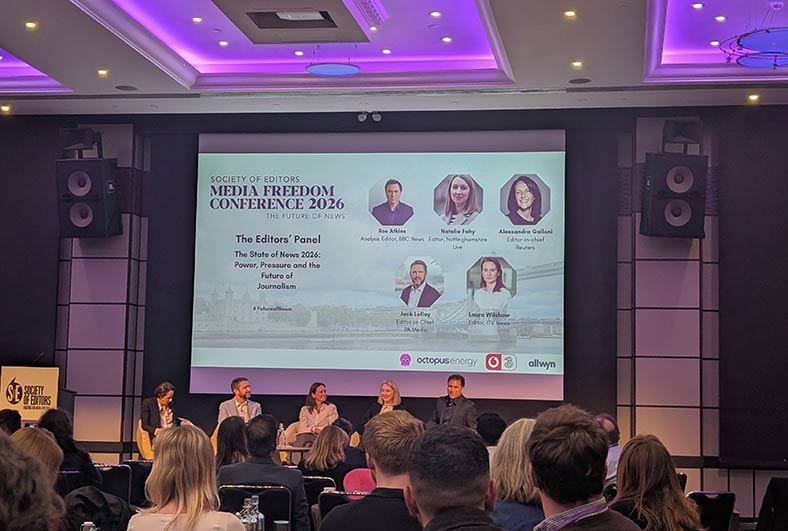
Check out the highlights and key takeaways from the conference here.
Platform priorities
News organisations are utilising social media to connect with modern audiences. For Alessandra Galloni, editor-in-chief at Reuters, it’s been good for appealing to those younger audiences and brand recognition:
‘I think there’s a misconception that younger audiences don’t care about news. It’s just that the way they consume it is different, and we’ve seen a huge rise in the number of young people who come to us via platforms like TikTok and Instagram. Historically, we’ve been known by other media organisations, and less so by the public. So for us, that presence is really important in terms of brand, but also it feeds into our website. A lot of traffic to our website comes via social.’
Laura Wilshaw, editor of ITV News, has also focused more on social media with the aim to ‘grow the digital audience and maintain the linear audience, too’. It’s been working on TikTok, where they now have the biggest political TikTok account. This also helps them reach younger viewers and is ‘important for growth, for reach and for trust’. They have also looked to do this on YouTube, showing a real shift from news outlets to focus on video. This is something that PA Media has responded to as Jack Lefley, editor-in-chief, explained:
‘We’ve pivoted to a video-first strategy. It doesn’t mean that the words or pictures produced by us are less important or we produce fewer of them, but it does mean we’ll be producing ever more video in all the formats that publishers and broadcasters need.’
PA’s shift has been more due to demand and Reach plc have followed suit. Natalie Fahy, editor of the Nottingham Post, said the organisation is moving towards more of a subscription-based platform ‘because we really value our journalism, value what we do, and people actually want to pay for hyper local content’.
Countering AI slop and provenance
For Jack, the biggest challenge for news organisations is that ‘the industry is a degraded information environment where audiences lose the ability to distinguish between verified journalism and synthetic knowledge’. This plays partly into the increase of AI slop flooding online spaces. Natalie, operating in local media, felt there was a simple way for her newspaper’s journalism to stand out:
‘We make people realise we’re real by actually being out in the community, and being present so people know who we are, they know our offices and they know they can meet up with us and come in. I think authenticity is really important’.
For a local news organisation, this is a simple and effective way to counter any issues with misinformation, disinformation, or AI slop, but this isn’t feasible for national and international outlets like Reuters, PA Media, and ITV News. Instead, the focus for Laura and Alessandra is on brand reputation.
Alessandra said that Reuters ‘traditionally has been synonymous with trust’ and therefore it’s about maintaining that. It’s similar for ITV, with Laura saying that the broadcaster is known for ‘eye witness journalism’ and ‘original investigations’ and they have to keep this reputation up, while also doing more around verification of material and sources. For Jack and PA Media, it’s about provenance:
‘Our provenance guarantee is that every story, every picture, every video we produce, will be produced by our journalist out on the road and will be checked by editors in the office.’
Making use of new technology
While AI poses threats and challenges in terms of ‘fake news’, it’s also increasingly being used by news organisations to save time and assist in the editorial process. Both Jack and Laura spoke of how they used it for transcription purposes, with Jack saying they also use it for archive retrieval and ‘trawling through huge data sets’. Natalie said that she has set up something similar at the Nottingham Post:
‘I’ve been using Google Gem to read Magistrates Court lists and highlight any interesting names (celebrities, etc.) or cases. It helps save a lot of time’.
Alessandra and Reuters have gone a little further with their use of AI and have developed a tool called ‘Fact Genie’ which extracts news from press releases and makes headlines out of it. They are trying to use AI tools to ‘help propagate important information in particular to the markets, to the financial terminal’ so that journalists have more time to investigate sources and get scoops. However, like the other news outlets, there has to be a human in the loop:
‘AI tools are good at the routine stuff. But they don’t have news judgement and that’s why you have to have humans in the loop.’
Concerns over journalist safety
Journalist safety has to be of paramount importance for news outlets, especially for foreign correspondents who are often in war zones. However, that doesn’t mean there aren’t threats here in the UK, and Laura and ITV have had to adapt to this:
‘Once upon a time, we may well have just sent a reporter and cameraman. We now use backwatchers all the time for protests, even if we’re not sure we’re going to need one, we don’t take the chance because you never know how things are going to escalate’.
Jack and PA Media are also conscious of this and make sure their journalists have ‘the right training and the right equipment and protective gear’. But he also mentioned the worrying trend of ‘right wing extremists targeting journalists on social media’. It’s something that Reach plc has tried to counter by appointing a permanent online safety editor. Natalie and the Nottingham Post have had their own politically-driven issues, with the outlet famously banned by Reform UK from the county council.
Alessandra and Reuters have had to deal with threats from the US government and reporters are still currently banned from the White House. And it’s continuing to have an impact on their journalists today:
‘There are more subtle intimidation tactics, including criminalisation, not necessarily of the journalists, but of sources. If you speak or if you leak something to a journalist, then you’re a criminal and you’re liable. That has a silencing effect on our sources, which then has a ripple effect on us’.