Blog / Events / Journalists
Challenges and opportunities for independent news in 2026
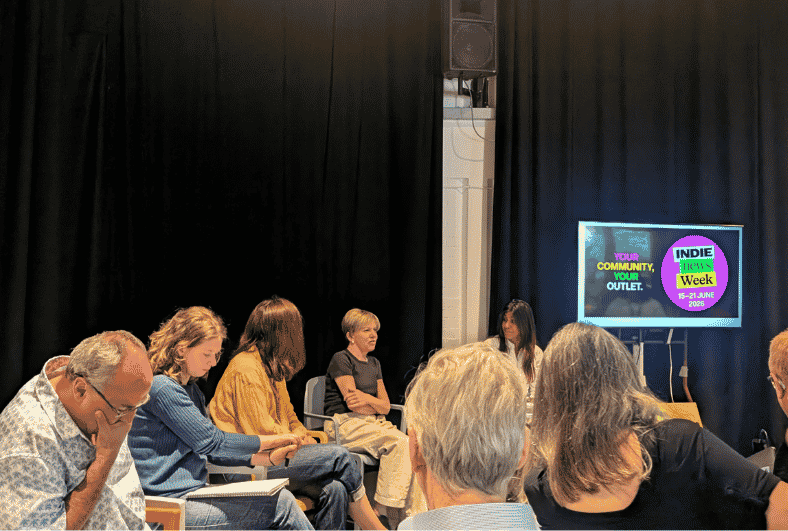

With the media landscape such a congested space nowadays, it’s a real fight to get the attention of readers – even more so for independent news outlets. For Indie News Week, journalists and contributors that work across the Greenwich Wire and Salamander News came together to discuss the current issues they face, especially in relation to covering local council news, and how independent news can thrive.
Business model concerns
Publishers and editors are experimenting with the way they run their independent news outlets, with various business models being used. Daryl Chamberlain, editor of the Greenwich Wire, doesn’t feel as though anyone has found a definite solution:
‘I don’t think we have found a business model yet for it. The old model was all about advertising because there was a buoyant used car market, a buoyant property market, and general classified ads. The internet has taken that all away and no one has really known how to deal with it’.
Both the Greenwich Wire and Salamander News are financed by reader contributions but both editors have considered advertising. Dorothy Stein, editor of Salamander News, asked her members for their opinion, and the reaction was positive, as long as it didn’t involve pop-ups. The team then looked into an ethical advertising agency that works with independent titles such as the Bristol Cable and Leicester Gazette. Daryl acknowledged the difficulty: ‘getting the infrastructure in place is hard to do’.
The government has recently promised investment into local news but this fund is geared towards digital transition and wouldn’t benefit the Greenwich Wire or Salamander News. Daryl has considered what benefits there might be to changing his business model and offering a print product:
‘I’m increasingly thinking that print is actually the way to go, because it has visibility, whereas with online we’re battling with loads of other sources and people struggle to tell my website from that from a number of other websites. Print would give it an identity’.
Improving relations with local councils
One of the major issues for independent news, and local news more generally, when it comes to covering local politics, is the loss of direct engagement between councillors and journalists. Mark Morris, a contributor to Salamander News, said that previously ‘councillors were accessible and wanted a two-way relationship’ but that has changed in recent years. He believes it’s up to them to make a change:
‘Councillors can talk to local media. I think a lot of councilors need to realise it’s not necessarily a bad thing. You actually should be feeding information sometimes and building up your relationship with the media’.
This was evidenced in the recent local elections in the UK with Lucy Giles, freelance journalist and reporter for Salamander News, saying that ‘there was a real lack of information about the candidates, aside from their own promotional material’. To get around this, the team decided to interview as many candidates as they could and give every single ward attention. Daryl also undertook this task at the Greenwich Wire and had 11,000 page views for the list of candidates in Greenwich – making it the third most read story of the year on the website.
Lucy feels that this enables readers to really ‘get to know the candidates outside of what they sell about themselves’ and underlines the importance of what they do: ‘that’s what local news is really for, to hold local authorities to account’.
Engaging the Next Generation
Independent news, like the wider media industry, needs to find a way to resonate with younger audiences. The challenge is twofold: affordability and relevance, as Lucy explained:
‘If you’re young, it’s an issue of cost. You have to show young people that it’s worth it, and that you’re involved in what they are interested in as well. In particular, that you understand them. They just want quality.’
The advantage, Lucy believes, is that ‘young people are coming from a context where the quality of local news was already poor when they started to read it’. Many news websites have pop-ups and lots of advertising which puts young readers off.
Tomilyn Hannah Rupert, a freelance writer for Salamander News, also feels that ‘young people are increasingly turning away from social media’ meaning that there is definitely an opportunity and ‘a market for quality journalism’.