‘If used well, AI can be a great asset’: Media interview with Jacob Granger, community editor at Journalism.co.uk
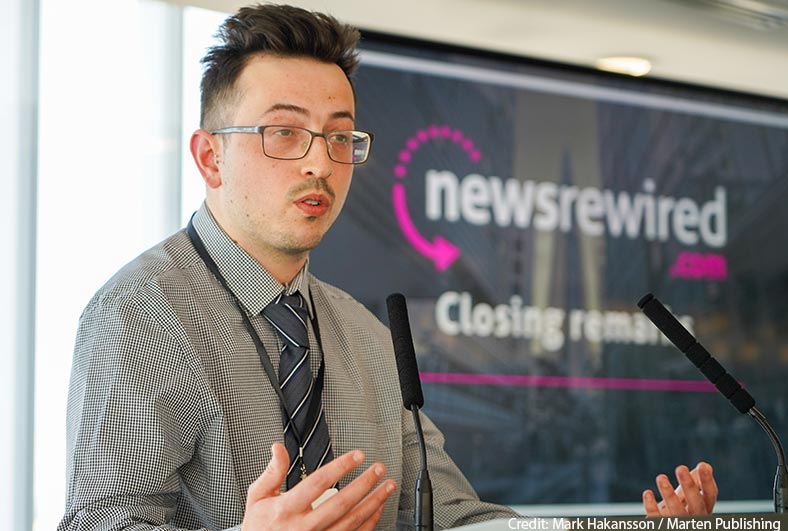

Community has become an important consideration for publishers in the last few years for retaining audiences in an increasingly crowded media market. It’s something that the team at Journalism.co.uk have also been thinking about as the company begins to move into a new era. We caught up with community editor Jacob Granger to discuss the changes to his role, the importance of journalism-related conferences, and the challenges and opportunities facing the media industry in 2025 and beyond.
Back in May this year you took on a new role at Journalism.co.uk as community editor, tell us a little bit about what the job entails
I would say it’s a job role in construction at the moment. For context, we went through an ownership change this year for the first time in the company’s history. My editor, Marcela Kunova, took over the company and is now the managing director. Part of the transformation is to replatform the site and fundamentally change a lot of our existing workflows and technologies that’s underpinning the business as part of that. Previously, for the last six or seven years, I’ve been working for Journalism.co.uk as the lead news writer, as well as doing a podcast every week, but what I felt we needed as we went through this transformation, is to get closer with our audience.
What I pitched for was to have a more cyclical model, because our audience are journalists and specialists in their own right. There’s a lot of value in that community, and I felt that we could do a better job of creating closer ties with them and imparting some of what they’re learning day in day out, in this really experimental moment for the news media, to the rest of our audience.
We’re still figuring out what that looks like. We are looking into a community space for our regular readers and users to come together and hopefully, there’ll be a lot of peer to peer exchanging of ideas. I also took on a big audience research project last year, to better understand what people want from us and where we can deliver value. Strikingly, what really came through, is access to experts who are figuring things out right now. My thinking is, how do we do that? How do we get journalists access to the people who are really at the cutting edge of our industry, which is going through so much change right now.
You also host the outlet’s weekly podcast, interviewing industry experts and senior media figures, who have been some of your favourite guests and why?
At the start of this year, I did a flurry of episodes around communities. It’s a really big trend that we’re seeing now, and it’s certainly becoming more important to think about communities. I really wanted to get into what exactly does a community mean today, because it’s a bit of a buzzword, and how are different publications catering for that?
It’s hard to pick one of these, but I think the one that really stands out to me is a guy called Andrew Brown, who leads an organisation called Stand up for Southport. The town went through a tragedy last year and we had a conversation about that community, and the rebuilding effort that’s going on there. We spoke about what and how news organisations can support that community, and what it’s like to support a community going through so much pain and the recovery and restoration. That really stands out in my mind, because obviously we had the anniversary, so it was a very poignant reminder of our duties as news organisations. I’d also say, connected to that, I spoke with Maria Breslin, editor at the Liverpool Echo, along similar lines. So those two are quite similar in their sort of lasting, fond memories.
Part of your role is also helping to co-organise the Newsrewired conference which happens twice yearly. How important are events like this for journalists when it comes to sharing information and practices and learning from one another?
Crucial. For a number of years now, it feels like we’ve been stuck in this never-ending experimentation mode. Experimentation can feel very lonely. I think I’ve learned this the hard way recently, going through all this transformation work. You try something, it kind of works and you take that lesson and move on to the next thing. When you find a community of people who are in the same boat, maybe hitting the same walls and finding little breakthroughs, it really matters to get outside the walls of your newsroom, to bust your assumptions and try new things.
What we try to do at Newsrewired is create spaces to have very frank and open conversations about experimentation, and really drill into the workflows and the nitty gritty bits. Look at what worked and what didn’t, as well as the more practical elements. We have workshops where there’s a real transfer of knowledge from people who are doing the hard work, to those who really want to roll up their sleeves and do it for themselves. So I’d say it’s really important.
And the next Newsrewired is coming up in November, what are you expecting some of the main takeaways to be from this event?
We partnered with an organisation called Tickaroo this year to help promote a survey to do with what young journalists perceive as the key challenges for them. This really drilled into what support they need, where they think the industry is headed, and I think a lot of media research doesn’t really focus too much on this cohort. It felt like a very special piece of research and a unique opportunity to know where this next generation sees the industry heading.
We’re going to take that research and put it to a panel of news industry leaders to see how these findings align, or not, with how they’re preparing their newsrooms and support for journalistic talent. We’ve got a really great moderator on this called Emaan Warraich. She’s a BBC journalist who’s got a great Tiktok account, so I’m really excited for her to lead the discussion. I’ll be sharing the data with her ahead of time, and I’m interested to know what she makes of it, and what she feels are the pressing data points coming out of that research.
It’s a very varied panel of leaders. One of them is Basia Cummings at The Observer. This has gone through a big change in recent times. It’s a great combination of legacy thinking, but under this new Tortoise partnership, a little bit of modern newsroom leadership thinking is in the mix. We’ve also got The Londoner, which is one of Mill Media’s regional titles. They are a very forward-thinking local news organisation and then The News Movement, which is a digital first, savvy, YouTube/Tiktok friendly news publisher. A lot of organisations which feel really aligned with this project and a good way to test the rigor of these findings, see how watertight they are and see how it aligns with their current thinking. That’s the panel I’m really excited for.
What would you say are some of the main challenges facing journalists working in 2025? And conversely, what are some of the opportunities that are available to journalists now and going forward?
The answer to both is AI, isn’t it? AI is clearly a challenge for journalists on a few counts. One is the pitfalls it poses to their reporting. There is a challenge there, where your reporting could look the same as any other AI imposter. So how does your journalism stand out as more credible and more trustworthy, in this potential ocean of AI generated content. That’s a really big challenge. How do you rise above that, that standard, and establish yourself as more credible and trustworthy?
The opportunity is there, because AI is being used and deployed in more and more creative ways at the moment. I think if harnessed properly with the right ethics, it can and it will help newsrooms to offload some of the baggage and put their humans on the stories that really matter. We are trying to make sense of this technology ourselves at Journalism.co.uk, trying to figure out how to make this work for us. I’m already finding it useful for researching, for preparing for interviews, and for drafting articles. All of this with a human lens and a human oversight, of course, but it’s really already making my life a lot easier.
It’s one of those double edged swords, where if used well, it can be a great asset. If not used so well, it can backfire.
Journalism.co.uk’s second Newsrewired conference of the year is taking place on 26 November and you can register for tickets here. Or if you would like to follow Jacob Granger’s work and podcast more closely, you can find him on LinkedIn.