Blog / Events / Journalists
Key takeaways from the Future of Media Technology Conference 2025
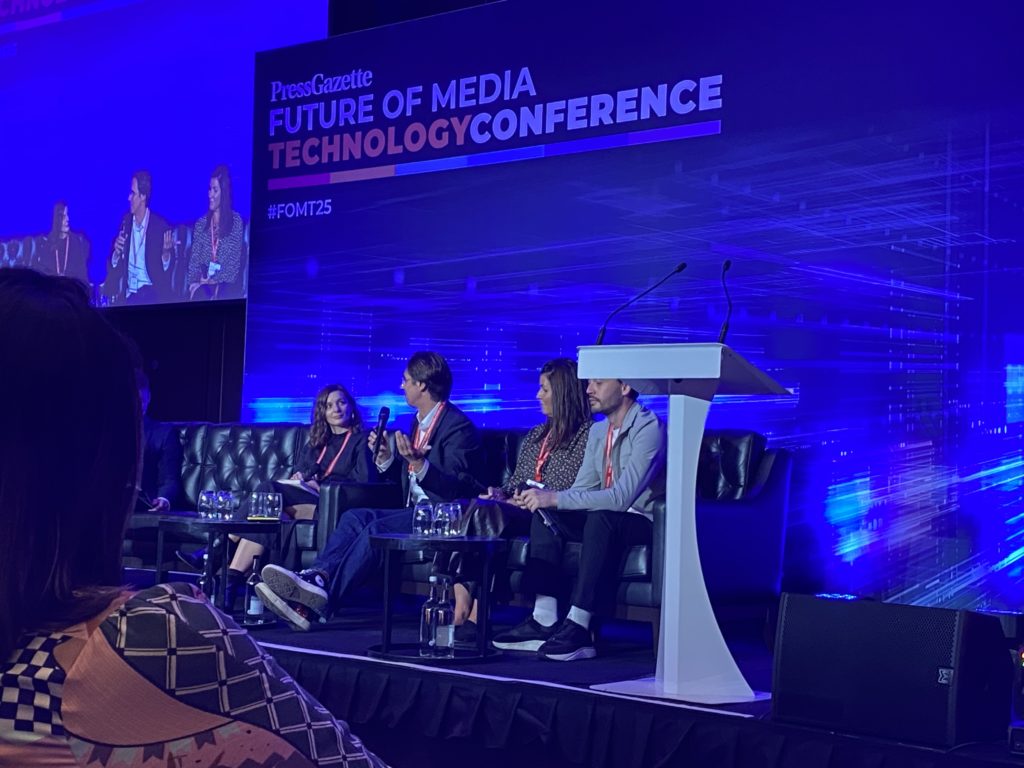

The Press Gazette’s annual Future of Media Technology Conference has become a staple in the media industry calendar, with a focus on what publishers are doing and can do to succeed in this ever changing landscape. There was a big focus on AI and its positive and negative impacts, but there were also important panels around paywalls, advertising, and reader traffic. Below are some of the key topics and talking points from the day.
The benefits of paywalls and challenges for advertising
A lot of publishers have already decided to move to a paywall for their online content. Sheena Peirse, chief customer officer at Mediahuis Ireland, is seeing the long-term pay off for putting titles such as the Belfast Telegraph behind a paywall:
‘If you put a pay wall up, you are going to see fewer ad impressions, but that’s short term. You’ll be able to get through it and at the heart of the B to C and B to B revenue is engaged readers. Your readers are incredibly engaged and loyal and they want to hear the news from you’.
The publisher now has over 100,000 subscribers after setting up paywalls back in 2020. Sheena also stressed the importance of collaboration between teams for this to work. The newsroom, product team, and marketing team have shared data and ideas which has helped generate this growth.
Digital advertising has been more of a challenge in recent years with many brands put off by the negative stories around the decline in news consumption. However, Imogen Fox, global chief advertising officer at The Guardian, says that ‘96% of people read news online in some form’ meaning there is still good value there for advertisers.
There is also concerns from advertisers around more sensitive news articles or ones that could be viewed as depressing, but David Goddard, SVP of business development at DoubleVerify, doesn’t believe that is the case:
‘News is 100% brand safe. There are sensitivities to particular content but the rest of the news is fantastic and high performing for advertisers.’
Overcoming reader traffic issues and monitoring the comments
A decline in referral traffic from Google search has been an issue for publishers for a number of years. It means that bringing in readers directly to the website is now more important than ever. Tom Rolfe, director of publisher development at OpenWeb, explained how this has required a mindset shift for publishers:
‘For quite a long time, publishers were very focused on that top of funnel traffic. We call it ‘free traffic’. But the mindset of publishers is now shifting to that mid-funnel engagement. So when the user hits the site, it’s the value exchange for the user and really focussing on keeping them there for as long as possible’.
Publishers are tackling this in different ways, with Caroline Fenner, chief revenue officer at PinkNews, explaining the brand’s creation of WhatsApp groups, Facebook communities, and subreddits for their readers so there is a ‘safe space for the community to feel like they belong’. While for The Times, the main focus is on getting subscribers to their app. This was redeveloped and relaunched in April 2025 and Anna Sbuttoni, deputy head of digital at The Times and The Sunday Times, said that readers are now ‘reading more widely and more deeply’.
The comments section can also be a good place to keep readers engaged and on the site, and build up a community. However, it does require carefully monitoring to avoid any trolls or toxicity, and Anna explained how they have taken steps to combat that at The Times:
‘We ask that anyone who comments registers themselves and they use their real name. It’s been a really positive step for us and really reduced toxicity. It creates that real community feeling of real people. There’s no mask there. It’s your name on your comment’.
Problems and potential with Google and AI
The Google AI overview has been in operation in the UK for just over a year now. This, along with advances in searches on platforms like ChatGPT, has been a cause for concern for publishers. Martin Ashplant, product development & operations director at PA Media, explained the changing relationship with Google:
‘I’ve worked on the publisher side for about 20 years before joining PA and during that time, it was mostly seen that Google were the ‘good guys’. The objectives were aligned. Publishers wanted to get good quality content out there and Google wanted good quality content on the web. That’s clearly changed and this isn’t just about AI. This is about how the Google interface has changed over the last few years and publishers can’t rely on getting that click’.
One option to counter that is to block the bots to prevent use of the content to inform the overviews. However, Carly Steven, director of SEO and editorial E-commerce at MailOnline, feels that the ‘only people that win in that scenario are the tech companies that provide products’ with publishers spending more on protection and the bot companies investing in evasion.
Carly also called for better signposting from Google AI overviews and AI chatbots about when the content is coming from publishers to show that it’s trustworthy. While Martin stressed the need to keep creating original content so that readers aren’t left with AI slop:
‘My call would be to make sure to invest in producing high quality journalism and putting original content out there which is yet to be scraped. If you lose that then you lose the reason for people to go out and be creative and get that original content, then we live in a far worse place.’
Looking for some high quality expert comment to add to your original piece of content? Find it by sending a request via the Journalist Enquiry Service. If you’re more in need of stats and information then try searching our Press Release Wire to add those finishing touches to your article.