Blog / Events / Journalists
Key takeaways from the Society of Editors Conference 2026
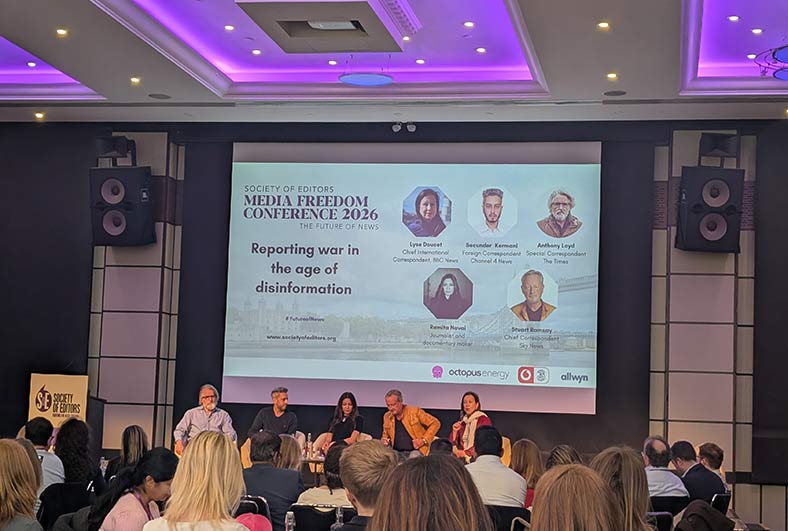

The future of news and the journalism industry as a whole is hard to predict in this ever-changing media landscape, but the Society of Editors aim to do so each year with their Media Freedom conference. The recent event saw some key announcements around police and the media, plus a speech from Lisa Nandy, Secretary of State for Culture, Media, and Sport. Below are some of the most important takeaways from the conference and what it means for the industry going forward.
Police and media charter launches
In the first panel of the day, John Battle, head of legal and compliance at ITN, and Rebecca Camber, chair of the Crime Reporters Association, announced the launch of the policing and media charter. Some of the key changes are:
- All police forces will now be contactable by phone and forces are obliged to send press releases of national significance straight to the media.
- Investigation updates will be released as soon as possible to stop social media speculation and any misinformation.
- Family liaison officers and press officers will be there to support relatives to speak to journalists when they are ready to do so
- Images from custody will be released on the day of conviction where there is a policing purpose or at the request of the media.
John said of the launch:
‘This is a new and unique document setting out, for the first time ever, an agreed, clear framework for the relationship between the police and the media, what information can be disclosed and when, the basis of when information can be disclosed and to who. It’s intended to promote consistent standards across police forces, and recognises the importance of open justice and the need for a successful working relationship between the media and the police’.
Ben Fishwick, editor of the Southern Daily Echo, said that it will make a difference as it allows a ‘two way conversation’ between the police and the media. Alan Woods, head of media and public affairs at the NPCC, pointed out though that it’s crucial ‘these documents are embedded both within police communications, but just as importantly, within newsrooms across the country’.
Support for local media outlets
The journalism industry as a whole has struggled with the rise of content creators and digital platforms, but one area that has suffered in particular is local media. In a speech to the conference, Lisa Nandy, Secretary of State for Culture, Media and Sport, revealed that nearly 300 local papers have disappeared in the last 20 years, and 22 have closed in the last four years alone. This has not only seen thousands of people lose their jobs but also ‘left millions with no dedicated local news provider’.
The government are therefore launching a local media action plan, which the Secretary of State outlined some of the key points from:
‘This strategy will; provide unprecedented funding for local media outlets to invest in new ways of distributing news; we’re almost tripling the funding for community radio; we’re harnessing the power of local and national government; and giving more young people access to free-high quality journalism, and the opportunity to pursue careers in it.’
She expanded further by saying that funds (which is a proposed £12 million) were available for local news outlets whether they ‘needed help to make the digital transition’ or if they were looking ‘to extend the reach of their existing publications’.
Countering disinformation during war and conflict
Disinformation and misinformation is a challenge for journalists across all sectors and topics. During the current conflict in the Middle East, Secunder Kermani, foreign affairs correspondent at Channel 4 News, feels that it has become even more widespread:
‘It seems in this conflict to me that misinformation has become turbocharged, and a lot of that seems to be because of decisions made in social media companies, particularly X. I still find it an incredibly useful and valuable platform, but we now have people who are pumping out misinformation, not just for ideological reasons, but doing it for commercial reasons and for engagement farming, and the algorithm rewards them’.
How can journalists counter this? Anthony Loyd, special correspondent at The Times, believes that ‘being familiar with AI is the necessity of the moment’ because ‘just as someone can fake an image with AI, there’s an awful lot of tools to prove that that image is fake’. Secunder also felt that for stories in countries where it’s difficult to get access due to the scale of conflict or restrictions on where the press can go then AI and OSINT tools can be used to ‘tell the stories from afar’ and this is especially useful ‘when there are contested narratives and contested claims around it’.
Ramita Navai, a journalist and documentary maker, did warn against the fetishisation of OSINT though and said that when it comes to covering wars and conflict then ‘good old fashioned witness reporting and sources still works well and has its place’.
Changes in political journalism reporting
Audiences are now, in many ways, easier to reach than ever before due to the plethora of social media channels that editorial content can be distributed out on. Younger audiences especially are getting their news this way and for Maria Breslin, editor at the Liverpool Echo, it means they have to have a presence there:
‘There’s a whole generation of people who source their news from different platforms now, and so it makes absolutely no sense not to go where the audience is. So if we’re planning coverage of, for example, the Labour party conference, we have to have a TikTok strategy to cover that’.
Similar changes and considerations have been made at Sky News as well, with Sam Coates, deputy political editor, saying that they have ‘spent a lot of time working out how we’re going to take the best content to audiences of the future’. This has resulted in a daily podcast which he hosts, previewing what people need to know about the day ahead for British politics.
Platforms like X (formerly Twitter) are changing too and Aubrey Allegretti, chief political correspondent at The Times, believes journalists are now using it more as a ‘notepad service,’ which he then explained further:
‘People are still using X or Twitter for that really live during the day conversation about where the narrative is going. And so being able to post on there and use some of those big social media platforms to be able to stimulate the narrative and the debate that’s happening in SW1 is really important’.