Blog / Events / Journalists
The enduring appeal of public service broadcasting and how it can remain relevant
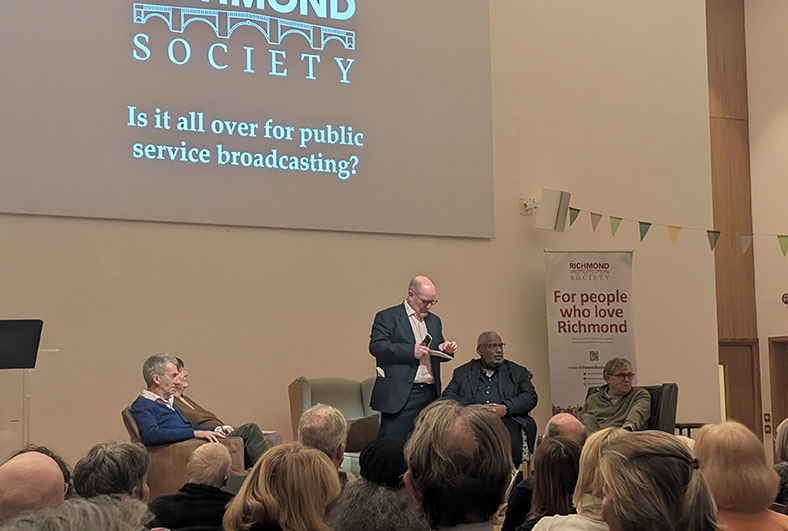

Staying relevant as a media outlet in an era of digital disruption and commoditised news is not an easy one for public service broadcasting. Whether institutions such as the BBC can survive and thrive in this new landscape was the talking point of a recent Richmond Society event. Ben Fenton, former chief media correspondent at the Financial Times, Shelagh Fogarty, presenter and journalist at LBC, Pat Younge, former chief creative officer at the BBC, and Peter Salmon, former head of BBC North, discussed the future of broadcast journalism.
Rebuilding and Uphold Trust
Traditional media has seen declining sales over the last couple of decades and this has largely been due to a decline in public trust. Ben Fenton said this is due to the ‘single biggest story I covered during that period, which was phone hacking. The destruction of trust in the written word as presented in newspapers was profound at that point’.
The newspaper industry has recovered slightly since then as Ben noted, but the media industry as a whole saw its reputation suffer. The advantage for public service broadcasting outlets like the BBC, Sky News, ITV and Channel Four is that they are regulated by Ofcom. That means they have to show due impartiality on issues such as political matters, and Ben believes it’s vitally important that these principles are upheld if broadcast news is going to continue to remain a trusted source.
Committing to the Audience and their Stories
The power of public service broadcasting lies in its commitment to the public, particularly at a local level. Shelagh Fogarty stressed the importance of listening to people and their stories:
‘If their stories demand further investigation, do it! Go to the people in power. Challenge them. Get to the bottom of their stories.’
She mentioned how the persistence of local journalists, as seen with the coverage of the Hillsborough disaster and the Post Office scandal, has led to real change and actions for people. It’s also, she added, why local radio was created, ‘to build something where people were in their communities’. Journalists can then listen to their stories and act on them. This is especially important for reaching younger audiences. Shelagh explained:
‘If you want young people to continue to go to the BBC or LBC or Channel Four or any of it, and believe that it’s worth paying for, you need to go to them and tell their stories about the issues that matter to them’.
Embracing Originality and Experimentation
Media outlets often have to cover the same major news stories and Ben Fenton believes that a lot of the originality has gone from reporting:
‘The news has become commoditised. It’s something that anybody could cut and paste and put together. Outlets are just copying what’s going on over there and trying to please all demographics and cover everybody. But in the process they aren’t actually pleasing anybody’.
Original reporting on certain issues and topics can really resonate with audiences, as Pat Younge says because ‘public service broadcasting matters. It’s who we are, it’s how we relate to each other and it’s how we tell our stories to our people in our language.’ He also believes that the BBC, and other public service broadcasting outlets, are a ‘great place for experimentation’. This helps further with originality but it can also lead to innovation which is crucial for staying ahead of media trends.